Kranji Marshes
Last Updated on 26 January 2026
After having explored Sungei Buloh Wetland Reserve numerous times, we figured it was time for a change of scenery. Enter Kranji Marshes, just down the road and brimming with fresh birdy possibilities.

Home to over 170 bird species, plus 54 species of butterflies and 33 species of dragonflies, Kranji Marshes is a quiet sprawl of reeds, pools, and open sky at Singapore’s northwestern fringe. Out here, the city quietly loosens its grip and nature takes over, speaking in wingbeats, whistles and the occasional dramatic fly-past.

This marshland owes its existence to some well-meaning engineering in the 1970s, when Kranji River was dammed to form Kranji Reservoir. The surrounding land flooded, birds and other wildlife showed up, liked the vibe, and collectively decided to put down roots. Migratory birds from the far north also check in every winter, treating the marsh like a seasonal all-inclusive resort.

Starting from the entrance at Kranji Gate, a gentle 1 km paved path skirts Neo Tiew Woods, doubling as an open-air classroom. Along the way, Weaver Shelter and Woodpecker Shelter invite us to peer out for rare and endangered birds, preferably without squeaking too loudly.

In the forested stretches, we could potentially bump into an impressive roll call of birds, like the Straw-headed Bulbul (Pycnonotus zeylanicus)…

…the Laced Woodpecker (Picus vittatus)…

…the Rusty-breasted Cuckoo (Cacomantis sepulcralis)…

…and the ever-ambitious Baya Weaver (Ploceus philippinus)…

…who tirelessly weaves elaborate funnel-shaped nests out of strips of grass to impress females.

The end of the path announces itself with the Raptor Tower, a tall spiraling structure that leaves us no choice but to climb.

Regret may surface halfway up…

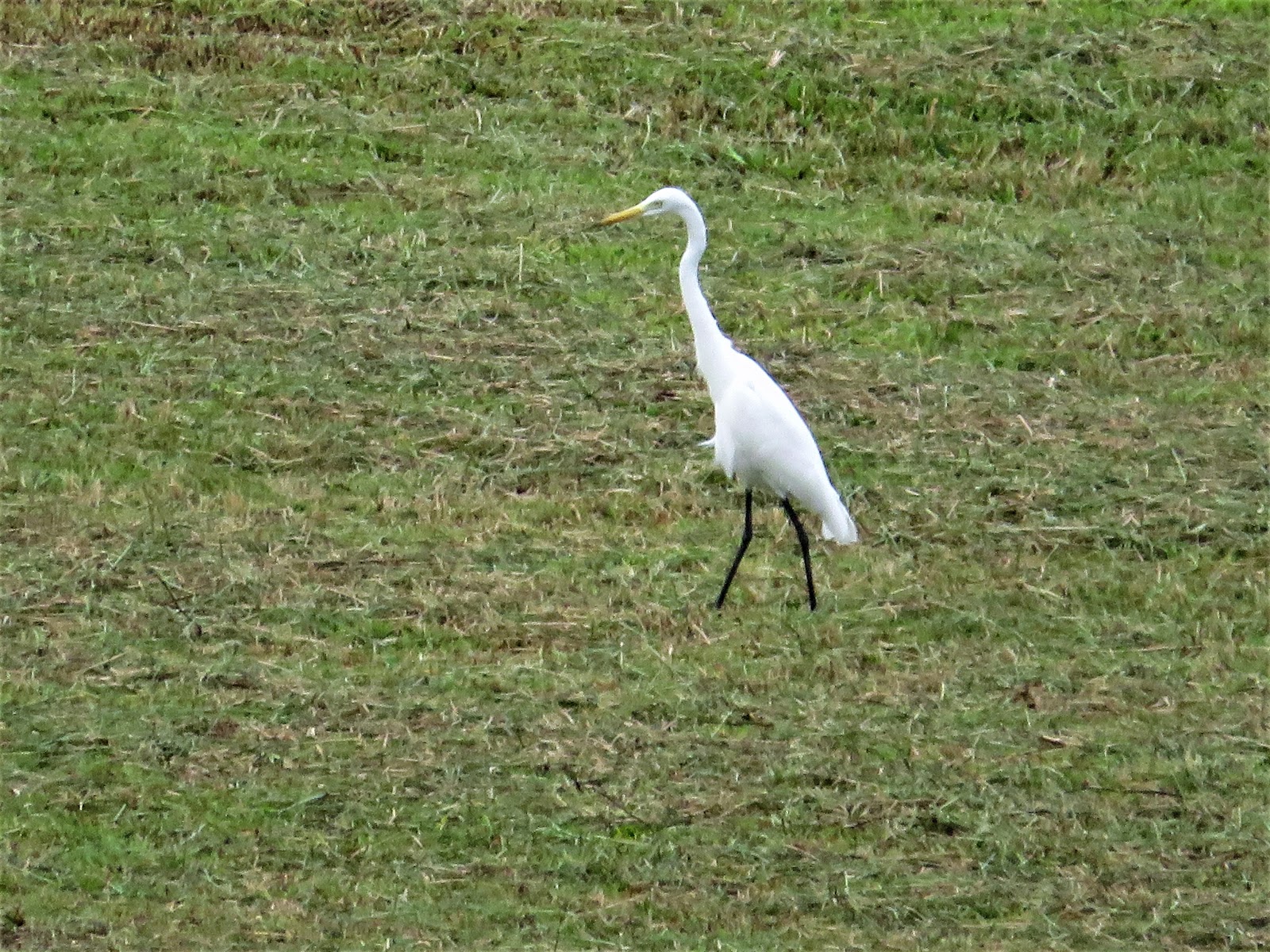
…but it vanishes once we reach the top and spot… well, at least an egret.
At the top of Raptor Tower, educational panels tease us with raptors we could only dream of seeing: Common Buzzards, Pied Harriers, Black Kites, and many more magnificent-looking winged creatures.

Realistically, we’re most likely to spot the White-bellied Sea Eagle (Haliaeetus leucogaster)…

…the Brahminy Kite (Haliastur indus)…

…or the Changeable Hawk-eagle (Nisaetus cirrhatus), all frequent flyers in Singapore’s skies.

Timing was on our side when several hundred Asian Openbills (Anastomus oscitans) suddenly swept past and circled overhead while we were at the top of Raptor Tower. These storks are usually rare visitors, so seeing them in such numbers was a genuine jaw-drop moment.

Normally found feasting on water snails in rice fields across the Indian subcontinent and northern Southeast Asia, they may have wandered south due to unusually dry conditions up north.

Asian Openbills are serious snail connoisseurs, particularly fond of Golden Apple Snails. Their distinctive bills, with a visible gap, are custom-built for prying stubborn snails out of their shells.

Back on marsh level, hides like Moorhen Blind and Swamphen Hide offer quieter vantage points for spotting elusive marsh birds.


At first glance, the marsh seems calm to the point of boredom, but sit still long enough and it reveals itself as a layered concert of chirps, whoops, and rustles.
The Lesser Coucal (Centropus bengalensis) announces itself clearly with alternating low “whoop whoop whoop” and higher “hoo hoo hoo” calls…

…while the Common Sandpiper (Actitis hypoleucos) pokes about in the mud for snacks.
The more secretive birds are rarely bold enough to show themselves out in the open, but the cleverly placed hides give us the perfect excuse to play paparazzi and catch these bashful characters on our spy cams.

Some of these elusive birds include the White-browed Crake (Poliolimnas cinereus)…

…the Watercock (Gallicrex cinerea)…

…the Pin-tailed Snipe (Gallinago stenura)…

…the Pallas’s Grasshopper-warbler (Helopsaltes certhiola)…

…and the Black-browed Reed Warbler (Acrocephalus bistrigiceps).

Under the Kingfisher Burrow, a cosy open-air classroom teaches us how to identify birds by their feet, bills, and hunting techniques.

With luck, we might also spot a White-throated Kingfisher (Halcyon smyrnensis)…

…or Common Kingfisher (Alcedo atthis) darting through the area like a living gemstone.

Although Kranji Marshes spans a generous 56 hectares, only 8 hectares are open to the public. The rest is a Core Conservation Area, politely off-limits to prevent us from stressing out the more introverted birds.
One exception is West Marsh, which opens occasionally via guided tours led by vigilant Kranji Marshals.

Naturally, we couldn’t resist stepping through that inviting gate….

…that beckoned us into the greener unknown of West Marsh.

The uneven paths are described as unsuitable for young children, though it’s really the children who are unsuitable, as their enthusiasm might send birds fleeing in alarm.

Of the many bird hides planted around West Marsh, only three are accessible to us: Duck Hide, Bittern Hide and Bee-eater Blind.
At Duck Hide, we happily ducked away from the sun while friendly marshals answered our many enthusiastic questions.

At Bittern Hide, we hoped for rare bitterns but were instead greeted by a Purple Heron (Ardea purpurea) emerging from the reeds with intense and ravenous eyes.

At the end of the 1-km path, Bee-eater Blind delivered yet another treat…

…with Little Ringed Plovers (Charadrius dubius) scuttling about and extracting worms from the mud. These migratory birds breed up north and reliably spend their winters sunning themselves in Singapore.

We noticed one plover constantly shaking its legs, one leg at a time, while feeding. We wondered if it might be afflicted with some kind of restless leg syndrome.

This is in fact known as the “foot trembling” feeding behaviour associated with plovers; the foot movements apparently help to stir up worms and other prey hidden at the bottom of the mud, where his short bill would not be able to reach. Once again, this proves that birds are far more clever than they look.


Beyond the marshes, nearby roads like Lim Chu Kang, Neo Tiew Harvest Lane, and Turut Track extend the birding adventure even further. But that, as they say, is a story for our next expedition.